We now have a facebook page which I’ll be updating a lot more often than this blog! So if you’re interested in seeing what our little homestead is up to, hop on over to https://www.facebook.com/hornespointhomestead. And if you have a facebook page too, let me know and I’ll be sure to meet up with you there!
Sunrise Chickens
Waking up early used to be pure torture for me, and by early I mean anytime before 10am. Now I do get up at 5am for work sometimes and if I wasn’t working, I would get up around 9am, but still, I’m a lover of some major sleeping in. That was the Before-Chickens era.
Nowadays the sky begins to lighten before 4:30am, with sunrise before 5:30am, which means I’m mostly up and out at the chicken coop around 5am. Now don’t get me wrong, waking up early everyday hasn’t become an easy thing for me to do, but it hasn’t been as dreadful as I had thought it would be neither. Sometimes I do lie in bed a few extra minutes, debating with myself whether I should just sleep a little more. But knowing how much the chickies love being outside at day break to gobble up insects that have moved into the run during the night, I trudge sleepily out to the coop. I call out to them as I open up the door, and they all come fluttering out, squawking excitedly. Pretty soon, they settle down, chirping contentedly as they scratch and peck and stretch their wings.
With a smile on my face as I stand among my little herd of chickens, all bathed in the warm summer sunrise, I realize that waking up at 5am has some very sweet rewards.
It’s only 5:30am, but hey, why not have a little nap together on the roost?
Ok so sometimes I actually get up closer to 6am than 5am, and a couple of times I did accidentally sleep in till close to 7am. Another confession, I am still looking forward to the time when the sun will rise at a much later hour.
Transformation in the Blink of an Eye
It has been super busy here in the past month and a half, but finally, here’s an update on my little chickie pies. They now range from 8-11 weeks old, and they have transformed from tiny fluff balls, to awkward scraggly looking teenagers, to mini versions of their future adult selves in about 2 months. I look back on these pictures and am just amazed at how tiny they used to be.
Here they are, tiny and fluffy, playing on a piece of sod and a little roost in their brooder (which they outgrew very quickly).
Another picture of tiny fluffy chicks playing with sod and a little roost. I have a lot of these pictures. I hadn’t realized how many similar pictures I had taken until I tried to pick some out to share with you on this blog. But to a proud chicken mom, each moment and picture is unique!
One of my sweet little speckled Sussex ran out to investigate the camera.
More tiny fluffy chicks warming themselves under the Brinsea EcoGlow 50. We were very happy with it. The chicks were able to have normal wake/sleep cycles without a glaring light over them 24hrs a day. They were very active out and about away from the heat most of the day, and slept soudly at night underneath it. It uses 60 watts and we had it on for 4 weeks before we moved everybody out to the coop.
Here they are starting to turn into awkward teenagers, digging through the dandelions and playing on another roost the husband made for them. Notice the gorgeous feathering on the speckled Sussex’s wing.
Here are the awkward teenagers sunning themselves on the roost. Notice the really awkward looking one standing up.
Awkward teenagers peering at me with their beady eyes. Three in the background taking a dust bath. We had to add another big box to the original brooder box so they don’t drive each other, and me, crazy, hence the square cut-out door.
And this picture is from last week, mini-adults. They grow up so fast, literally.
And here is “my darling” whom I mentioned in the previous post. He was the friendliest chick from the start, was the first to hop onto my hand whenever I reached into the brooder to do anything, and eventhough he’s a much bigger boy now (at least I think it’s a boy), he still wants snuggle time everyday.
Meet Our New Chicks and Brooder Tour
3 Fuzzy bums!
I’ve been wanting chickens since last summer, and on May 4th we finally picked up our chicks! We drove about 5.5 hours each way to get them, and it was a long and tiring day, the wonderful husband did all the driving. We ended up getting 25 chicks of various ages from day-olds to maybe 2-3 week-olds. A little white chick died a bit after we got home, it was very weak and couldn’t lift its head, and it was bent backwards. Then a speckled sussex died sometime overnight. The next morning we noticed a black australorp with droopy wings, not eating and drinking, so we quarantined it with a warm oatbag, some water and food, but it died that afternoon. Three deaths in less than 24 hours had us really worried, but we now have 22 very healthy and active chicks.
In total, we have 3 black Australorps, 3 speckled Sussex, and 16 others that are a combination of white Plymouth Rock, Columbian Plymouth Rock, and I think white Phoenix. I can tell which ones are the Phoenix since they have slate coloured legs, and I’m beginning to be able to see which ones are Columbians since their black feathering is starting to show a little. As much as I like baby chicks for their adorableness, I’m really looking forward to when they’re fully grown and their individual personality really shows. Plus taking care of baby chicks is a lot of work! They’re awake from 5am to 8:30pm and other than a couple of short quiet times, they’re constantly on the go, eating, drinking, digging, scratching, fluttering, perching, playing, all the while chattering non-stop.
Here they are eating. We give them non-medicated chick feed which we lacto-ferment. For more on lacto-fermentation of chicken feed, see here. It doesn’t look very appetizing, but it doesn’t smell bad. It smells just like sauerkraut, the real kind that’s made with just cabbage, salt and water. I find using the traditional chicken waterer to give them fermented feed is better than using a big dish, otherwise they like to hop right in and get all wet.
Here they are basking in the sun and playing with a piece of sod. I also dig up whole dandelions for them and they love to scratch and peck at them too.
You can see the chicken nipple waterer we use in this picture. It keeps the water clean and the bedding dry. We also add a bit of unpasteurized apple cider vinegar with the mother in their water. For the first week, I also put some organic, unpasteurized honey in the water as well.
Here’s a little video of the chicks scratching at the sod and bedding. We use the deep litter method and with 22 chicks in the house, it doesn’t stink! Once in a while you get a whiff of something, but then I just go and aerate the bedding with a garden trowel and add more pine shavings. Plus the chicks are really good at digging and fluffing up the bedding themselves. Now the brooder may not smell like poop, but there is a slight sweet musty smell that’s not unpleasant. The bedding is probably about 5-6 inches deep now.
And here’s a video of them taking a short afternoon siesta. I have come to treasure these short quiet times. We use Brinsea’s EcoGlow 50 instead of a lightbulb to warm the chicks. It’s like a mother hen. If they need warmth they huddle underneath it, but I have to say, the chicks spend the majority of the day running around eating and scratching. The room temperature averages around 21C or 70F and they seem very comfortable and active. It also provides a more natural day/night rhythm instead of having a light on them 24/7. The only downside to the EcoGlow is that the chicks love to perch on top of it and make a poopy mess.
As for naming them, I simply call them all “Chickie Pie”. Except for one Columbian who likes to hop onto my hand and roost on my arm. I call him/her “my darlin”, I don’t know if I’ll be able to eat that one.
I’ll end with this little speckled Sussex, all tuckered out from a very busy morning.
Updates Galore
Ok here goes!
Winter Vegetable Garden
Ummm, so I think the last time we really picked any veggies from our winter garden was on New Year’s Eve when the husband cooked an amazing meal for us. There was duck and poached pears involved, among other deliciousness. But we really didn’t shower it with the love and attention it deserved. I think we might have cracked the window covers on the green house boxes once on a sunny day, and cleaned the snow off them once. Also, the husband reported back around January that some moles or voles have been digging under the green house boxes to get at our Endive and our Merveilles de Quatre Saisons (fancy heritage French lettuce). Apparently the little fuzz balls have expensive taste. You can see what the winter vegetable garden looked like in November here. Anyways, pretty much the only one that’s barely hanging on is the frilly kale, everything else has disappeared, leaving behind them nice clean patches of soil. We also experimented with whether we could store carrots in the ground over the winter…we could not, they turned to mush. Perhaps if we had a constant snow cover and did not have so many feeze/thaw cycles it would have worked. But the parsnips seemed to have stored better in the ground, the husband harvested quite a few on Monday.
CHICKENS!!
Hopefully by the end of April we’ll be driving to the mainland to pick up our chicks. I had requested 12 black Australorps and 12 speckled Sussex, but it looks like the speckled Sussex won’t work out and we’ll be picking 12 of whatever else the breeder has hatched at the time. We’re aiming for standard bred, dual purpose heritage chickens that’ll be a pleasure to raise on our homestead, and a pleasure to eat. We’ll have to wait around 5 months to taste our first home-raised chicken and 6 months for eggs. We have spent months researching and preparing, and we’re excited!
Maple Syrup
We boiled down the last bit of sap we collected a week ago and pulled out the taps. I thought to myself, it’s a good thing it’s still cold outside and we need the heat in the house anyways, but for two days it was over 26C in the livingroom and it was hot!
Spring
I never understood why new years start in the winter. For a farmer wannabe, the new year starts when you see your first crocus. But I suppose that doesn’t really work for southern farmers who don’t get to experience all 4 seasons. And for those who know me, yes, I do have some reservations about the upcoming season of black flies, mosquitoes, horseflies, june bugs, earwigs and wasps. Here’s to hoping no wasps inside the house this year, and no black flying beetles that buzz and float into the washroom as I’m sitting on the throne.
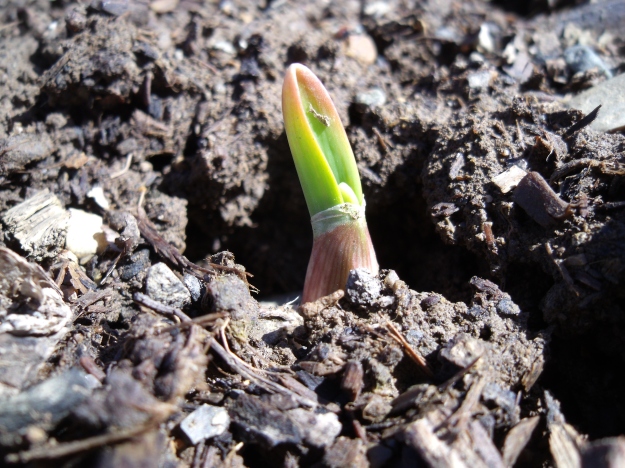
Some of the garlic we planted in the fall have sprouted! Did I mention that we’re supposed to get 10-15cm of snow tonight and tomorrow and that I’m a bit worried for them?!
Thankful
Well I think that’s about it. It has been a quiet winter, yet dotted with some life changing events, the sudden death of a young friend, and some health issues in the family. But in the midst of it all, we could still see how good Jesus is, and we’re so thankful, and we’re filled with hope.
Farming in Taiwan
After our two-week whirlwind trip back to my homeland Taiwan, 40 hours of total travelling time back to Canada, and one week of recuperating from jet lag, I’m finally feeling slightly more normal. We had a wonderful time visiting family and sightseeing, and even learned a little bit about farming in Taiwan.
During our trip down the east coast of the island, we ate at this little traditional family restaurant by the road. We learned that all the vegetables we had for supper were grown right behind the restaurant, so after we stuffed ourselves, we went out back and toured the owner’s vegetable garden. The setting was beautiful, nestled among the vast fields of rice paddies with layers of mountains and clouds in the backdrop. He was so gracious and humble about his garden as he showed us around and answered our many questions. He talked about how he tries his best to not use any chemical pesticides and fertilizers, how he ran out of room on the ground for his squash so he had to move them onto the trellis, and his large variety of crops.
What struck me most was that although there may be all sorts of cultural differences between us and this man, when you start talking about growing vegetables in your backyard, those differences disappear.
This is a field of bananas and pineapples further down the east coast.
A young pineapple.
These are Bananas wrapped up in bags. Someone told me that to reduce or eliminate the use of pesticides, bananas, among other fruits in Taiwan are wrapped up by hand, which is partly why organic produce cost more than the conventional ones.
A tea farm. There are tea leaf picking machines, but if you want to enter national and international competitions, you must pick and select the individual leaves by hand.
This is the best picture we have of rice paddies, taken from a moving train. We were told that the rice grown on the east coast of the island is better than the west coast since the east has very little industry and factories, and the water the rice is grown in comes straight from the Central Mountain Range .
After enjoying the warm temperatures of Taiwan for two weeks (27C), we came back to 0C and blustery winds. We also found out that while we were away, a flock of Canada geese has moved in onto our field! I hear geese manure is good for pasture, and they have been so entertaining to watch.

Maple Syrup 2013
23 more days until the official start of spring! The weather here for the past few days has been beautiful. Clear blue skies, with night time temperatures below 0C and day time temperatures around 7C, perfect for collecting sugar maple sap.
After the husband washed all the buckets, taps and hoses, out we go, traipsing through the snowy fields and into the woods. This year we’re tapping 4 of the larger sugar maples. There are many more, but they’re still too small to tap. The husband knows these woods so well, he knew exactly which trees we were tapping and where they were. It seems so natural to him, but to a city girl, or a new country girl, it just baffles me because everywhere I go in the woods, it all looks the same to me!
Anyways here’s the husband using a brace and bit to drill a hole for the tap or spigot.
Here’s the tap inserted into the sugar maple.
For the larger trees like this one, we can safely put in 3 taps.
Hopefully soon I’ll have pictures for you of the sap we’ve collected, and the boiling process.
Pâte à Choux avec la Crème Pâtissière
We’ve been trying to bake exclusively with organic whole wheat flour for the past few months, but the other day the husband wanted to bake some Irish soda bread, so we thought we might as well buy a bag of organic all purpose flour. I must say, it’s been kind of nice to have some in the house! While I find cookies and muffins and cupcakes do taste better with whole wheat flour, there are some things that I long to bake that just will not work with the heaviness of it, such as cakes, croissants, and pâte à choux. Before I go any further, did you know that there’s a Society for the Preservation of Irish Soda Bread? I wish I had taken a picture of what the husband made! But I think I was sleeping at the time…
Anyways, I didn’t take pictures of the step by step process or the crème pâtissière since I got the recipe from The Little Teochew and she has gorgeous pictures and clear step by step instructions. It took me awhile to make since it was my first time, but I was surprised by how easy it was despite its impressive sounding name. But then I think anything in french sounds impressive. They puffed up beautifully and tasted wonderful, slightly crispy on the outside, hollow and just the right moistness on the inside, and the crème pâtissière was lovely. I think I made them too big though, they were way bigger than my fist! My mom made them for us a few times when I was younger, and I had a sudden hankering for them the other day, so here it is!
First Major Storm of Winter 2012-2013
It didn’t stop snowing/ice pelleting from Saturday 0400 to Sunday around 1800. It was the first major storm we’ve had in these parts for two or three winters now, and I so wanted to take some pictures so I could share the scenes with you. With northeast winds gusting up to 80km/hr though, and with the whipping snow and ice, I decided to stay indoors during most of it. We got a total of about 45cm, but the strong winds created snow drifts so that I was wading in the snow up to the top of my knees under the apple tree, and suddely came out and was stepping on green grass, I enjoyed the neat contrast. The husband braved the fury of the elements however, and tried to keep the road to the outside world clear in the old tractor until the blizzard got inside the tractor somehow (he knows the correct lingo, I don’t) and it stopped working.
I did manage to take a picture of one of our apple trees, its branches hanging low, heavy with ice. When the wind blew, the entire apple tree was clincking and jingling like an oversized wind chime. It’s just how I imagined Narnia would look and sound like.
After the freezing rain started, this was the view from one of the windows…
I read in the news that a small number of people from the States and Canada died in this storm. I’m glad the casualty was not any higher, but even one is too many. I hope you and your loved ones fared through the storm and that your little ones enjoyed playing in the blizzard!
A Medley of Things January
I think January is one of my favourite months. It arrives amidst the hustle, bustle, clamour and joys of the Christmas season, and passes by in hopeful stillness before the busy spring and summer months are upon us. It is a subtle and silent month, bursting with hope for the year to come, and that’s what makes it beautiful to me. Here are a few curios from around our homestead.
Our confused Christmas tree, thinking that it’s spring, has started growing cones.
Stacking wood for next winter.
The first real snow we’ve had that’s stayed on the ground came on New Year’s Eve day, and ever since then, it’s been around -14C with the windchill.
More snow today!
It’s been fascinating to watch the ice growing over the river in the past few days.
A clincker built boat from the 50s, upside down with saplings growing through the hull.
Angelica
Knitting on cold, silent January days.
Hope you’re having a lovely January too!
A Merry Little Christmas
This will be our very first Christmas together as husband and wife, and it will be a quiet and simple fare as we revel in God’s love showered down on us through Jesus.
Add a tree from the homestead, old ornaments from generations past, some new ornaments and a star, and you get a lovely, rustic little first Christmas tree.
The husband scoped out a potential tree the week before. It’s a 10 metre tall balsom fir and since they don’t live too long after they reach a certain height, I didn’t feel bad about cutting it down. The rest of the tree will be turned into firewood. As we were traipsing through the woods to get our tree, I saw a bunch of perfectly sized and perfectly shaped evergreens all along the way and asked why we couldn’t just get one of those instead. The husband explained that they were called Cat Spruce and they’ll make your house smell like cat urine.
The first ornament we bought together.
An old hand painted ornament.
A wooden bell the father in law made many years ago.
New ornaments and an old bell in the background.
Two birds.
The star.
Merry Christmas!!
Why I’m Dreaming of Chickens by Day & by Night
The chickens you see in the header are not my chickens, if only they were. No, these chickens belong to the Fortress of Louisbourg, and from what I can tell, they are a Mille Fleur variant of some breed of heritage chicken. Aren’t they beautiful? I snapped their picture three summers ago, little suspecting that my life’s path would lead into the country.
Let’s see if I can condense months of research and prayerful rumination into short concise points:
- The chicken meat we purchase at the supermarket are all Cornish Crosses which, if they’re actually able to mate can’t reproduce Cornish Cross chicks. The only people that can reproduce Cornish Cross chicks are those who work at Tyson Foods, Maple Leaf Foods, and other large corporations depending on the country. That means anytime a farmer needs more Cornish Crosses, they can’t breed their own but must purchase them, a wholly unsustainable practice, and makes lots of money for those large corporations who carry out so many morally questionable practices.
- The Cornish Cross were bred for fast growth, and can be processed in 37 days compared to the normal processing time of 126+ days depending on the breed. The Cornish Cross grows more rapidly than its heart, lungs, and other vital organs can handle, thus they frequently die of respiratory and cardiac failure. They also grow too fast and too big (particularly the breast muscle, which is where the money’s at) for their pelvis and short legs and often can’t even walk but waddle or just sit, or their legs are simply broken from its weight.
- Chicken farms that supply meat for major corporations and thus the supermarkets house the Cornish Crosses at a density of about 25,000 chickens per warehouse. Usually one worker would look after about three of these warehouses. Because of this overcrowding and unnatural environment, the top beak of the chicks are either grounded or melted shorter than the bottom beak, which research has shown to cause acute pain for the chicks, so that the chickens won’t peck each other to death. The overcrowding and poor immune system of the chickens also require vaccinations and medicated feed in order to prevent the spread of diseases.
- A chicken that lives and dies in 37 painful and distressed days while eating highly processed and medicated feed, which by the way contains genetically modified corn and soy that has numerous known and unknown deleterious effects on the environment and human health, can’t possibly be good for the people who eat it.
- Even at the local farmer’s market, the only chicken we can buy are Cornish Crosses. They may have lived in better environments out of doors and on green pasture, but they still grow way too fast and can’t walk and breathe right.
- Eggs we buy at the store come from hens packed into battery cages, each one living on less space than an 8.5×11 piece of paper for 2-2.5 years before their egg production drops and are slaughtered. Due to overcrowding, these hens are required to undergo the same treatments as the meat chickens. All male chicks from the commercial egg production strain are killed en mass as they don’t lay eggs and are not good enough to be meat chickens.
- If the egg carton advertises its eggs as “organic”, it means the hens were fed non-medicated and non-GM but still highly processed feed, and still kept in battery cages. “Free run” eggs mean they’re not kept in cages but on the warehouse floor, and “free-range” eggs mean the warehouse must have some sort of access to an outside area of a specific size, neither has anything to do with the feed they get. Even if each hen gets more space than in a battery cage, it is still much too overcrowded in my opinion.
It’s not just the poultry industry, the entire food industry and agri-business is off kilter because it is founded on all the wrong motives. Basically, we want things cheap, easy, and fast, regardless of the sanctity of animal life, our all-important role as stewards of the resources we’ve been given, and that healthcare is costing us more every year.
But hey, I’m no purist. I still succumb to the temptations of McDonald’s once in awhile, and right now we still buy meat from the supermarket. I loathe to do these things but I realize that change does take time, so we just do our best one step at a time.
Steps we can take:
- If you’re permitted to own a few chickens in your backyard for meat or just for eggs, go for it. If you’re not allowed, find like-minded people in your area and speak to local government representatives to change the existing bylaws.
- Try to buy your meat, dairy, vegetables and fruit from local farmer’s markets. Get to know the farmer, find out how their animals are raised and how their fruits and veggies are grown. Ask lots of questions and support the local farmer.
- Ask farmers at the local market if they sell heritage chickens instead of Cornish Cross. It’ll likely be very hard to find, but if enough people ask for it, things just might change! Vote with your dollar!
- Grow your own vegetables in your backyard, or even your front yard, in bins and flower pots, bags and glass jars.
- Try to buy organic where you can. To be certified organic in Canada, fruits and vegetables must not be genetically modified and must not have been sprayed with synthetic pesticides and fertilizers, and livestock must be fed organically grown, non-genetically modified and non-medicated feed, as well as no hormones allowed.
- Try to decrease the number of times you eat out, and find restaurants that support local farmers.
Rather than thinking of yourself as someone who is against all the things that are wrong with our food industry, think of yourself as someone who is for food that is healthy and wholesome because it has been raised and grown by loving stewards whose desire is the health and wellbeing of his livestock, his customers, and the earth.
So which chicken breeds am I dreaming about? That will be the subject of another post!
100% Whole Wheat Baguette (My Attempts)
Yesterday mid-morning I was rummaging through the fridge to see what I could cook for supper and the only meat that we had was half of a frozen snow crab left over from this past Spring. So I decided to make crab chowder with lots of onions, potatos, carrots, and of course, lots of butter and cream too. Then I thought how nice it would be if we had fresh out of the oven baguette to dip the chowder with!
This will be the second time I made whole wheat baguette after tweaking a few things from my first attempt. After much searching online, all the recipes I could find used some amount of white flour, except the recipe of one blogger who also had the same difficulty, so she decided to go it her own way to see if it works. She reported that the first time it did work out wonderfully, but subsequent attempts with the same recipe was not as successful. There were also mixed results from others who tried her recipe in the comments section, though I think most did turn out well, so I decided to give it a try too. I did substantially increase the amount of kneading time and rising time as I thought the low level of gluten in the whole wheat flour, as well as the low house temperature and humidity level required it. Here is the original recipe, it is a lovely blog with lots of wonderful meal ideas!
As a disclaimer, I’m not an expert in baking, I’ve hardly baked a thing my whole life until I got married! And I have read that bread making is affected by altitude, temperature, humidity, and a bunch of other factors so that if I were to bake more baguettes tomorrow from the same recipe, it might come out a little different. So treat what I write here as a general guideline for what has worked ok for me. I’ve never been one to follow recipes anyway, my eyes just glaze over, and besides, with so few ingredients, no matter how badly it turns out, it’ll still taste like bread. The difficult part is tweaking things so you get the texture and consistency you like.
Ingredients
1 1/4 cup very warm water (I don’t know what temperature, I just boiled some water then let it sit for a bit until it has completely stopped giving off steam but still hot)
2 3/4 tsp dry active yeast
2 tbsp turbinado sugar
1 tsp salt
3 cups organic whole wheat flour
Steps
Combine the water, sugar, and yeast in a large mixing bowl. Let stand about 5min. (The mixture sat there for about 8min as I got busy with something else)
Add salt and 1 1/2 cup of the flour, stir until everything is mixed well.
Add another 1 1/2 cup flour, use your hands to form a dough.
Knead for 15min.
Let stand for 3 hours, cover top of bowl with towel. (To facilitate better rising than my first attempt, also because the kitchen was hovering around 20C, I sat the bowl on top of a heated oat bag, pictured below)
The dough should be doubled in size, punch it down and knead again for 15min.
Let stand for another 2 hours.
Knead for about 5min, then divide dough in two and form them into baguette looking shapes. Put them on baking sheet that’s lightly oiled or sprinkled with flour.
Cut diagonal slits on top, then brush top with some water.
Let stand for about 20min while you preheat the oven to 400F with a small bowl of water. (The steam from the water is what makes the outside of the baguette crispy)
Bake for about 15min or golden. (I don’t think my oven is all that great and I don’t think the temperature is accurate either!)
Et voila, c’est tout!
After kneading the dough for a total of about 35min, waiting for five and a half hours, cracking the tough and stubborn snow crab legs and claws to get at its tasty morsels, and peeling and cutting out the questionable parts of the home-grown potatoes, supper was served at 7pm, and promptly finished around 7:20pm. Ah well.
This was the dough before I let it rise for the first 3 hours.
This is the oat bag I talked about. Its main purpose was for warmth on cold winter nights, but it was very useful in this application too! I heated it for 3min in the microwave, it needed to be reheated a couple of times throughout the rising time. You can use hot water bottles or whatever, but whimsical skiing cats are a nice touch.
This is after 3 hours of rising.
After some more kneading and letting it rise for another 2 hours, I kneaded the dough for a few minutes more, then formed them into the desired shape. Can’t wait to pop them in the oven!
Not the prettiest looking things but quite tasty, especially with the crab chowder! The husband enjoyed it very much.
I hope you will enjoy making your own 100% whole wheat baguettes as well! Waiting for hours to see what you end up with is half the fun! Do keep in mind that it’s not going to be as light and airy as white flour baguettes, but you’re getting all the healthiness of the wheat, not just the empty carbs. I also just learned that whole white flour is the same as whole wheat flour except it’s made from an albino strain of wheat. Perhaps next time I’ll try it with that, since it has the same benefits of whole wheat but the colouring of the baguette will be more like the pictures in my head of what a baguette should look like.
Two nights of -8C/17F & Still the Vegetables Keep Coming
Last night I decided to make filets de sole en papillote for supper, which is just French fancy talk for fish and veggies and herbs baked in a pouch of tin foil. I put on the husband’s Dunlop rubber boots and clomped out to the garden to see what I could find. It has been quite cold for the past week and a half, with frosty nights and mornings, and for a couple of days it went down to -4C to -6C in the daytime and -8C during the night, with 2-3cm of snow covering the ground. The greens we had planted especially for the winter were doing well in their cold frame, but the Parsley and green onions continue to surprise us with their resiliency. We had enjoyed them for months now, and thought they’d be done in by the first few frosty nights so we didn’t bother protecting them from the cold. Well, there they were, not as tall and bushy as three weeks ago, but the Parsley was still growing new baby leaves even after the freezing temperatures and snow!
We’ve left the carrots in the ground to store over winter rather than harvesting and storing them someplace else. We’ll see how they do in the months ahead. I love that little rush and thrill you get in the split second between pulling on the carrot, wondering how this particular carrot will look, and feeling it come loose from the soil as you catch your first glimpse of it! Simple joys and excitements are much more poignant I find, and leaves a deeper and more lasting impression.
These are mutant but cute looking carrots due to the clay soil being too clumpy. Won’t win any prizes but just as delicious.
Lesson in Patience: Garlic Planting
When I was a little girl I used to despise garlic with a passion. I would sit at the dinner table and patiently pick out every single little piece of garlic, and if I missed one and bit into it, my blood would boil. It just tasted so digusting to me! Well now that I’m much older, I’ve started relishing foods that I hated as a child, including rice, fish, green onions and even ginger! We use garlic a lot in our cooking now and it’s such a versatile ingredient in that depending on how you cook the garlic and when you add it to the pot, it can give you a whole range of different flavours.
Well we decided that we wanted to grow our own garlic instead of having to buy them from the grocery stores, which are all imported from far away places. From what we have read on different websites, garlic is supposed to be quite easy to plant and grow, so why grocery stores need to import them from half way across the globe is beyond me. Anyways we ordered two varieties of garlic from Annapolis Seeds, the Spanish Roja and the Susan Delafield, and we’re going to have to wait 8-9 months just to get a taste of them…if they turn out!
This is the Spanish Roja. It’s a medium sized garlic with red streaks. It’s supposed to be strong and pungent, productive and reliable, with 6-8 cloves per bulb.
We carefully separated the cloves, making sure the basal plate wasn’t still attached to the cloves.
And this is the Susan Delafield. It’s a large sized garlic with fewer but big cloves. It’s also supposed to be more tolerant to wet soil, which is a good thing for us with our rainy Autumn and Spring and our clay soil.
Hopefully this patch of ground will provide us with lots of delicious garlic next summer! Anything worth having is worth waiting for, and we thank God for life and growth and yummy food!
Isn’t it Lovely to Pick Fresh Green Veggies on a Wet & Windy Cold November’s Day? (And a Roundup of This Summer’s Bounty)
Thanks to reading Niki Jabbour’s book which introduced us to the wondrous possibilities of vegetable gardening well into the winter months, we decided to give it a try this year and planted our first autumn/winter garden back in late August. We went with the cold-hardy varieties recommended by the book of course, and bought most of our seeds from Annpolis Valley Heritage Seeds. We didn’t plant too many varieties as this was our first year of experimentation, but mostly because I got lazy and didn’t get on the researching and ordering early enough, and time was running out to get the seeds in the ground so they’ll be mostly grown before the frost hits. Oh and we didn’t have time to work up a new patch of ground for this project so we had to use the spare space that was left over from the spring and summer. Anyhow, the seeds were sown and now it’s November and we’re still eating fresh greens from our own garden and it feels really good!
We planted the frilly variety of Red Russian Kale which sprouted within a few days of planting and grew quite quickly, we were enjoying them maybe two to three weeks after planting. We also have Mizuna which amazed us by sprouting less than two days after the seeds were sown! They’ve grown like mad and are the best at keeping the weeds at bay. The Arugula hardly grew at all and I think this one might have needed to be planted earlier. We also bought a heritage French lettuce called Mervilles de Quatre Saisons from Hope Seeds which, judging by google images might still be in its baby stage and I’m not sure how much more they’re going to grow, but they’re reddish and pretty and tasty. Lastly we bought Endive and Spinach from the local Co-Op and the Endive has done alright except where the deer has been trampling, but the poor Spinach has just now only the tiniest sprouts visible. It probably needed to be planted much earlier too like the Arugula. Lastly we planted some more carrots and while I don’t think we’ll get large sized results, we should have some nice medium sized ones along with many baby carrots which cost a lot of money in fancy restaurants. This post has been more wordy than I’d planned it to be, but here are some pictures!
This picture was taken in late October. The Frilly Kale is at the top of the picture, the bare and weedy patch of ground in the middle has Arugula seeds hiding beneath the soil, and the Mizuna is at the bottom of the picture.
Here’s a growth comparison between mid October and now…they really haven’t grown all that much more and I don’t think they will anymore now that it’s really getting cold. On the other hand, the weeds are growing pretty good! The Endive is on the left and the Merveilles de Quatre Saisons is on the right in each picture.
And here are the carrots. We have more in another garden which were planted in the Spring.
The green onions/Scallions and Parsely are doing surprisingly well. We planted them back in Spring and they’re still looking pretty good.
Left overs from the Summer harvest
Speaking of the Summer harvest, it felt so good not having to buy vegetables at the grocery store for the past three months! I so disliked wheeling the shopping cart around aimlessly, wondering where the vegetables came from and what they were sprayed with, and how unkind the farming practices were to this marvelous creation as well as to our bodies. Though we did buy lots of mushrooms at the store, we hope to try growing our own sooner than later. We were able to go out into the garden and pick fresh the vegetables we wanted to eat in a few hours and it gave me such a sense of accomplishment and wellbeing. We enjoyed Zucchini Squash, Spinach, Romaine Lettuce, Snow Peas, Yellow Beans, Green and Red Swiss Chard, Carrots, two types of Tomatoes. On top of our own crops to enjoy, the father-in-law planted several varieties of potatoes which are are too numerous to list here, two kinds of turnips, beets, and five kinds of squash. Oh yah, there were also copious amounts of strawberries! We had to eat a bucket of them everyday for about five weeks, not counting the many bags that were frozen as well as made into jams.
I tried making just four jars of strawberry jam with Turbinado sugar instead of white sugar. I wasn’t sure if they would turn out as jams are so finicky in terms of the fruit to sugar ratio, but they seemed ok. The husband enjoyed them. His exact words were “Mmm! It tastes like fruit roll-ups!” I was hoping for something a little more gourmet tasting, but as long as he likes them!
Well I hope I didn’t bore anyone to death reading this long post about our garden! This was really more of an exercise for me to slow down and reflect back on the past few months, what needs to be tweaked, and also just how much there was to be thankful for!
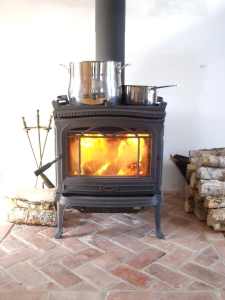
Our New Woodstove!
Our woodstove project has been a long time in the making, and it was finally completed this past weekend just in time for the chilly weather that is now coming through.
These are some “before” pictures of the old coal fireplace insert. It has such lovely character and we hope to be able to use it for decorative purposes somewhere else in the house down the road. Notice the very old wallpaper which was revealed after I had peeled off the newst layer of wallpaper months ago.
And these are some “after” pictures. The bricks we used for the hearth came from the other chimney in the kitchen which we took down earlier in the spring. They were made locally in the early 1900’s, which gave it the historical and sentimental character we were looking for.
I didn’t put up the pictures of what happened in between the “before” and the “after”. The husband did an amazing job and made the end result look like it was a piece of cake to do, but just taking down the existing fireplace and the area around it was loads of work, not to mention the chimney work, putting up new dry wall, preparing the floor to lay bicks, then planning out and laying down the bricks in the beautiful herringbone pattern, then adding mortar, then cleaning and sealing. There’s still some finish work to be done such as trim, wallpapering and painting, but the real hard work is completed and we’re very thankful.
And here it is all fired up for the first time!
It takes a bit longer to heat up compared to other woodstoves without the cast iron outer layer, but once it does heat up, it gives a wonderfully cozy, comfortable and even radiant heat. As beautiful as the stove is, I feel like the herringbone brick hearth really steals the spotlight!
An Exciting Post About the Bathroom Sink
Since this is a blog centering on the happenings around the homestead and the renovations of this old farm house, I thought I’d write a little update about the bathroom sink.
For several months now the old existing sink was not draining properly, it was quite maddening, but there was just simply no time to fix it. Finally, it got to the point where it was hardly draining at all and the husband took action.
Hmmm, why isn’t the sink draining??
Because the area around the drain was all rusted out and clogging up the sink!
Thankfully the sink didn’t completely rust through or we would have had a very wet bathroom floor. And here’s the new sink!
And just to make this post more interesting, here’s the view from our bathroom, believe it or not.
Playing Catchup
Well we’ve been living in this old farmhouse on this old homestead for almost six months now, so it’s probably about time we updated you with the goings-on in this place!
Spring arrived with the grape hyacinths
the daffodils and tulips
and the plum blossoms and apple blossoms.
With the arrival of spring, various critters also came along for the fun. There were blackflies, horseflies, mosquitos, june bugs, house flies, cluster flies, wireworms, earwigs, and the dreaded wasp or yellowjackets, several of which made it into our kitchen. Much comforting was required from the husband. I do not have lovely pictures of these.
Besides these awful critters that made me severely question God’s aesthetic sense, there were thankfully creatures that reminded me of my romaticized notions of what it would be like to live in the country and at one with nature. There was the mother fox with her young pups playing by the barn, practicing their hunting skills with the newly planted potatos spuds. There were the adult deer with the young fawns foraging across the pasture in the early morning fog, iridescent blue dragonflies darting among the field of timothy grass as they swayed gently in the breeze, and gigantically fuzzy bumble bees flying from clover to clover, whose buzzing sounded as low as the husband’s voice.
There were lots of new experiences, new knowledge gained, adjustments made, bewilderment, and laughter. More to follow on the summer season, renovations, and whatever else we can think of.